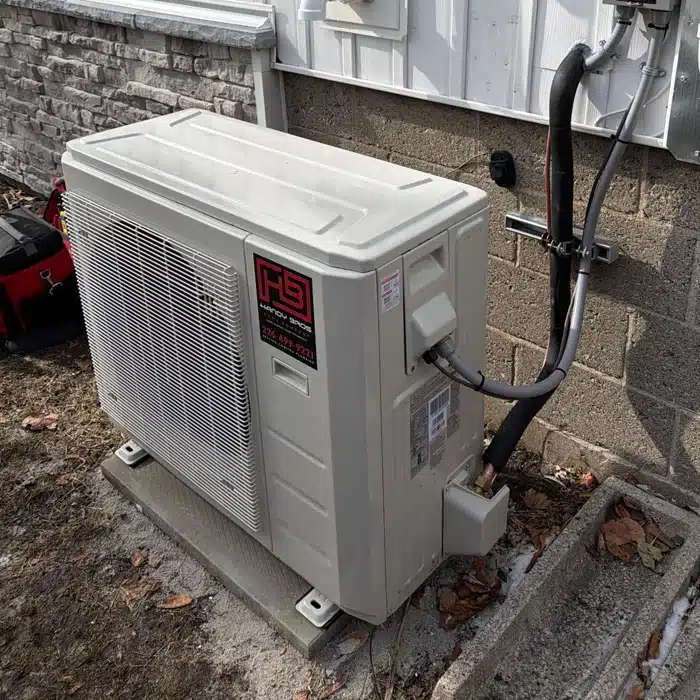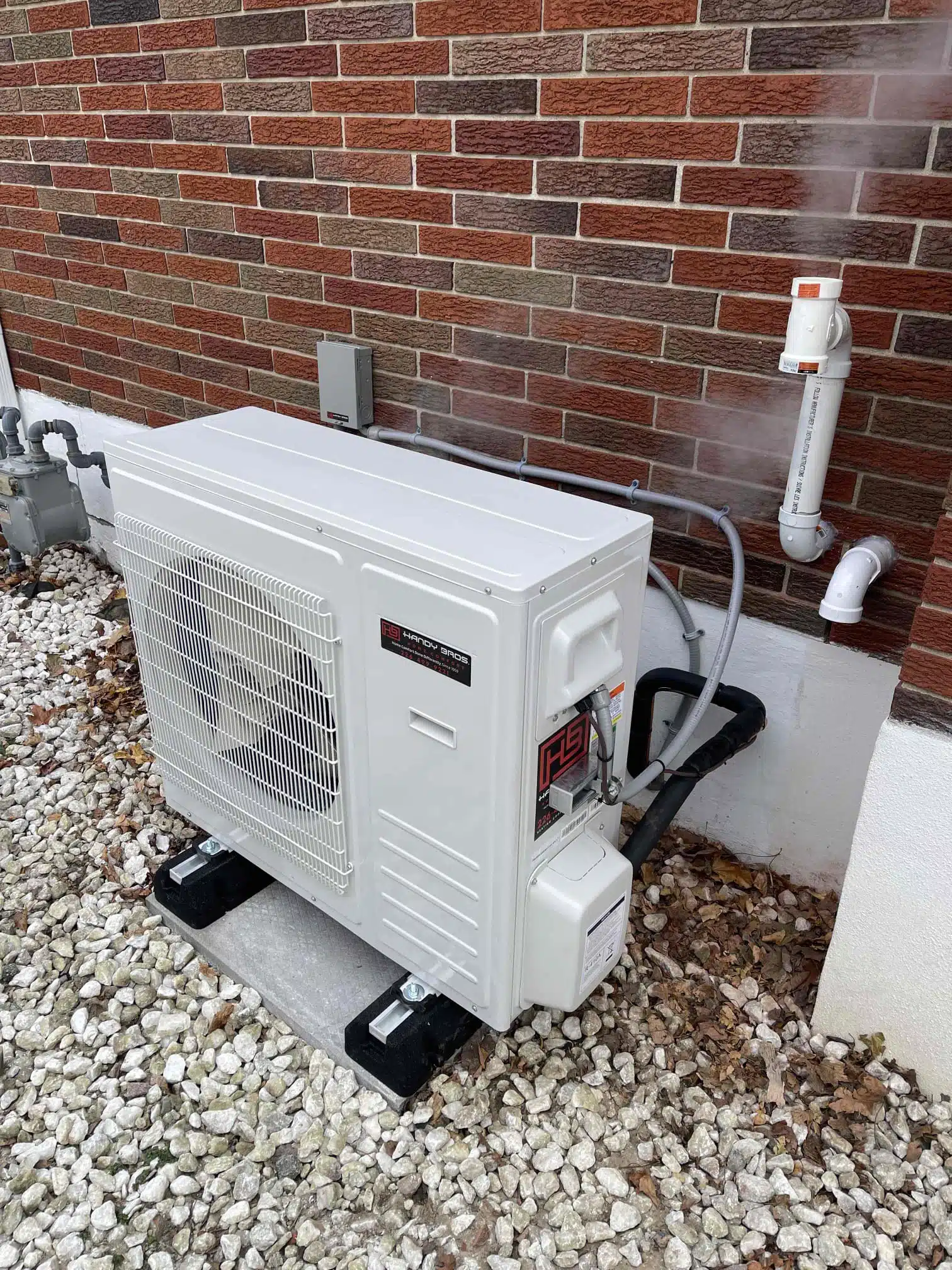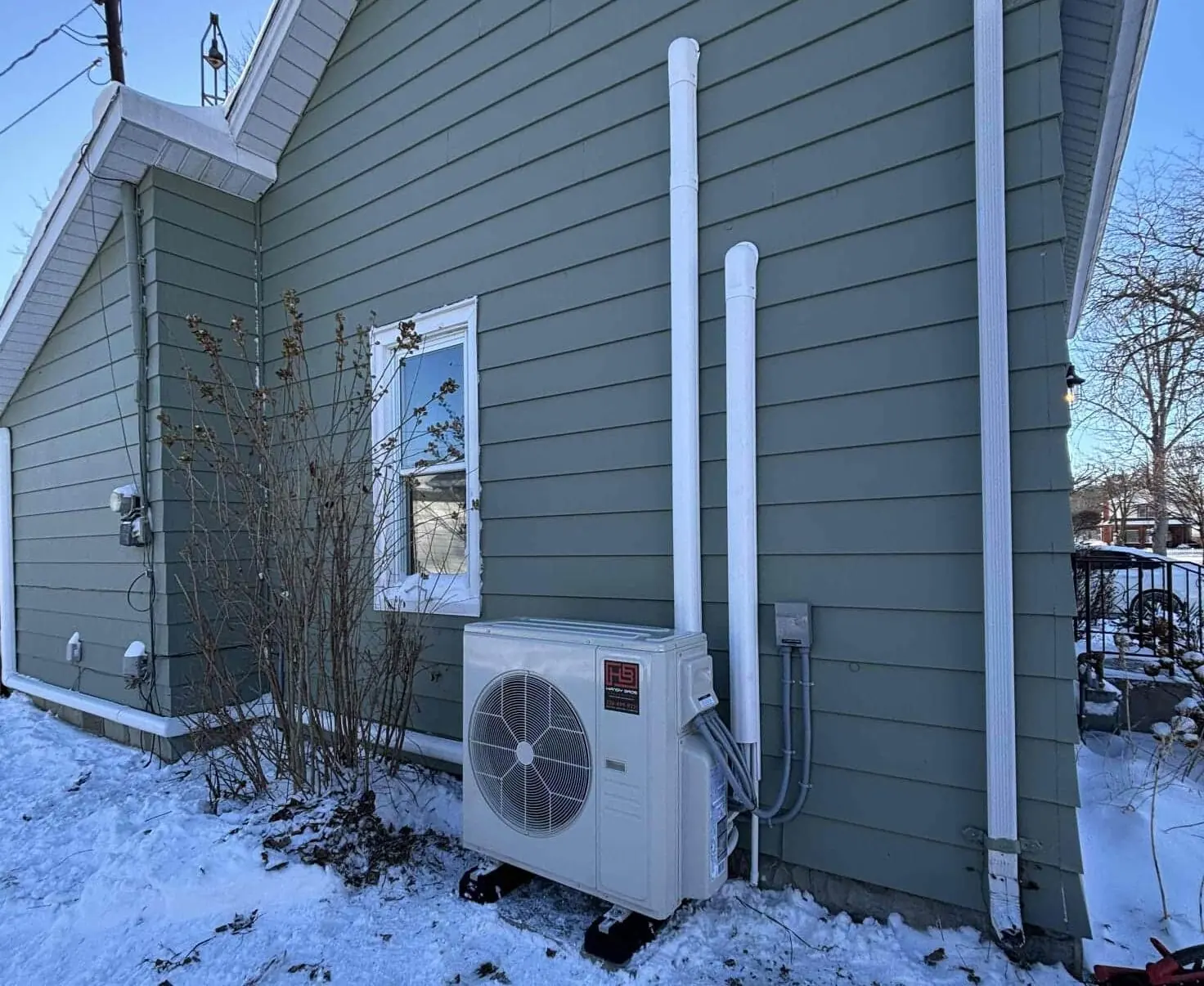


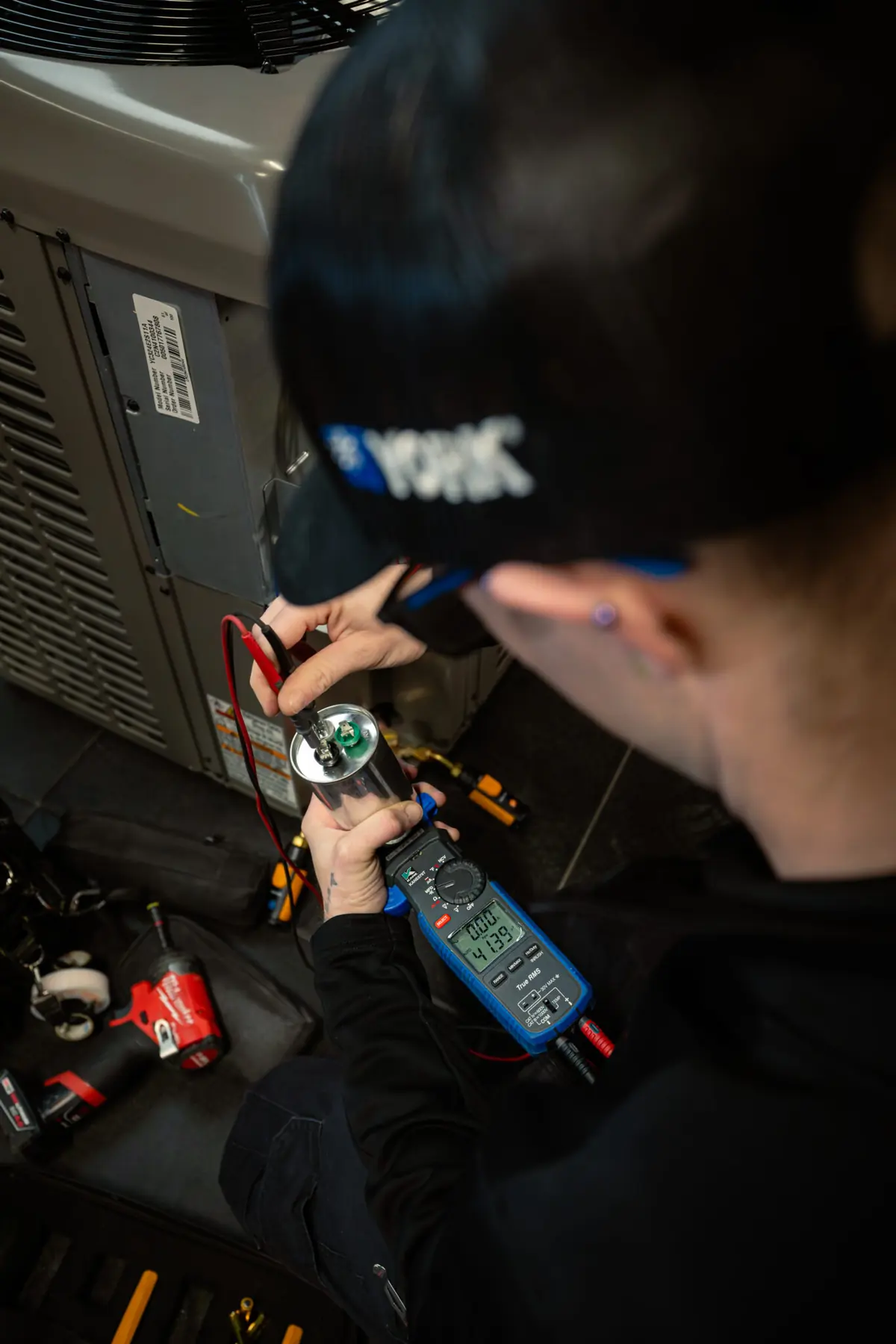
Residential AC refrigerant is one of the most misunderstood parts of a home cooling system. Many homeowners in London, Ontario hear terms like R-22, R-410A, R-454B, R-32, “Freon,” “Puron,” “low refrigerant,” or “AC recharge” and wonder what it all means.
Here is the simple truth: refrigerant is not fuel.
Your air conditioner should not “use up” refrigerant like a car uses gas. An AC system operates in a closed loop. If the refrigerant is low, there is usually a physical leak somewhere in the system.
And too often, those leaks trace back to poor installation.
At Handy Bros., this is exactly why we do Home Comfort Done Differently. Our team does not believe in rushing equipment into a home, hoping it works, and leaving homeowners to deal with expensive problems later. Residential AC refrigerant has comfort, safety, legal, environmental, and financial implications. It needs to be handled by trained professionals, installed correctly the first time, and verified through a clear inspection process.
For London HVAC homeowners, this matters even more. London has a wide range of home ages, from newer subdivisions to older properties with aging HVAC equipment. That means homeowners may be dealing with anything from an old R-22 air conditioner to a modern R-410A system, or now, newer equipment designed for low-GWP refrigerants.
Let’s break it down in plain language.
What Is Residential AC Refrigerant?
Residential AC refrigerant is the substance inside your air conditioner or heat pump that absorbs heat from inside your home and moves it outside.
Your AC does not create cold air in the way many people think. It removes heat from your indoor air. Refrigerant is what makes that heat transfer possible.
In a properly installed and sealed system, refrigerant moves through the indoor coil, outdoor unit, compressor, and refrigerant lines over and over again. It changes pressure and temperature as it moves through the system, allowing your AC to cool your home.
That is why the right refrigerant charge matters so much.
If there is too much refrigerant, too little refrigerant, the wrong refrigerant, or a leak in the system, your AC can struggle. You may notice:
• Weak cooling
• Long run times
• Higher hydro bills
• Ice on the refrigerant lines or coil
• Warm air from the vents
• Strange noises from the outdoor unit
• Repeated service calls
• Compressor damage
A refrigerant issue is not something to ignore. It can become costly fast.
Why Low Refrigerant Usually Means There Is a Leak
One of the biggest myths in home comfort is that air conditioners simply need to be “topped up” every few years.
That is not how a healthy AC system should work.
Your refrigerant system is sealed. If refrigerant is low, it usually means refrigerant has escaped. That leak may be in a coil, line set, service valve, fitting, brazed joint, or another part of the system.
Sometimes leaks happen because equipment is old. Metal can corrode. Coils can weaken. Vibration can take a toll.
But in many cases, leaks are caused by poor installation practices. That can include:
• Poorly made refrigerant line connections
• Improper brazing
• Not pressure testing the system properly
• Not pulling a proper vacuum
• Incorrect refrigerant charge
• Rushed setup
• Poor airflow setup that puts extra stress on the system
• Lack of final inspection
This is where the lowest-price installation can become the most expensive choice.
A poorly installed AC may seem fine on day one. It may even cool the home for a while. But if the refrigerant circuit was not installed, tested, charged, and inspected properly, the homeowner may pay for it later through leaks, breakdowns, comfort issues, and major repairs.
The History of Residential AC Refrigerants in Ontario
To understand why refrigerant matters today, it helps to understand how refrigerants have changed over time.
Ontario homeowners may have AC systems from many different eras, especially in cities like London where homes vary widely in age. The refrigerant in your system often depends on when the equipment was manufactured.
Pre-1995: The CFC Era
Before the mid-1990s, some older systems used refrigerants such as R-12 and R-502. These are CFC refrigerants.
These refrigerants were phased out because of their ozone-depleting impact. In Ontario, older ozone-depleting substances are tightly regulated under Ontario Regulation 463/10, which covers ozone-depleting substances and other halocarbons.
Most homeowners today will not have a standard residential central air conditioner running on R-12. It was more common in automotive AC, chillers, and refrigeration applications. But the key takeaway is this: old refrigerants are not casual service materials. They are regulated substances that require proper handling, recovery, and disposal.
1995–2009: The R-22 Era
For many years, R-22 was the standard refrigerant used in residential central air conditioners.
Many homeowners still know R-22 by the brand name “Freon,” although that name is often used casually and not always accurately.
R-22 worked well, but it is an HCFC refrigerant with ozone-depleting potential. Because of environmental concerns, new air conditioners using R-22 were phased out, and production and import of R-22 has been heavily restricted over time.
For London homeowners, this matters because many older homes may still have older AC equipment designed for R-22.
If you have an old R-22 system, you may still be allowed to operate it, but repairs can become expensive. The refrigerant is no longer widely available as newly produced product, and service often depends on recovered or reclaimed supply.
That means a refrigerant leak in an old R-22 system can create a tough decision: repair an aging system at a high cost, or replace it with modern equipment.
2010–2024: The R-410A Era
After R-22 was phased out for new residential AC equipment, R-410A became the dominant refrigerant for central air conditioners and heat pumps.
R-410A does not contain chlorine and has zero ozone depletion potential. That made it a major step forward from R-22.
But R-410A has a high global warming potential. Because of that, Canada has been phasing down HFCs through federal rules under the Ozone-depleting Substances and Halocarbon Alternatives Regulations. These regulations control HFCs through bulk HFC phasedown rules and controls on products containing or designed to contain HFCs, including refrigeration and air-conditioning equipment.
Most modern AC systems installed over the last decade likely use R-410A. These systems are not suddenly useless. Many can still be serviced. But the industry is shifting again.
2025 and Beyond: Low-GWP Refrigerants
Newer air conditioning and heat pump equipment is now moving toward lower-GWP refrigerants such as R-454B and R-32.
These refrigerants are part of the next generation of HVAC equipment. They are designed to reduce environmental impact while still providing strong comfort and efficiency. Manufacturers have been transitioning product lines toward these newer refrigerants, including R-454B for many ducted systems and R-32 for many ductless applications.
However, they also require updated training and handling procedures. Many of these newer refrigerants are classified as A2L, which means they are mildly flammable under specific conditions.
That does not mean homeowners should be afraid of them. It means HVAC companies need to be properly trained, properly equipped, and serious about following the correct procedures.
At Handy Bros., that is exactly why we invest in in-house training, certification, and detailed installation standards before our crews ever step into a homeowner’s home. Our Triple-A Certification standard is built around consistent quality, team training, and accountability across the customer experience. If you want a deeper breakdown of the transition, we also explain the key risks of 454B vs. 410A for Ontario homeowners.
Refrigerants Are Not Cross-Compatible
This point is extremely important.
Refrigerants are not interchangeable.
An air conditioner designed for R-22 cannot simply be filled with R-410A, R-454B, or R-32. A system designed for R-410A cannot simply be topped up with a newer refrigerant because it seems more modern.
Each AC system is engineered for a specific refrigerant, pressure range, oil type, metering device, coil design, and safety standard.
Using the wrong refrigerant can cause:
• Poor cooling
• Equipment damage
• Compressor failure
• Safety risks
• Warranty problems
• Code and compliance concerns
• Costly replacement
When a homeowner is told, “We can just put something else in it,” that should raise a red flag.
The right answer is to identify the system, confirm the refrigerant type, inspect for leaks, recover refrigerant properly when required, repair the issue correctly, and charge the system according to manufacturer specifications.
That is not guesswork. That is professional HVAC work.
Ontario Refrigerant Rules Homeowners Should Know
Homeowners do not need to memorize every regulation, but they should understand this: refrigerant handling is regulated because it affects the environment and public safety.
In Ontario, Regulation 463/10 sets out rules for ozone-depleting substances and other halocarbons. It includes rules around refrigerant discharge, equipment servicing, testing, and who is allowed to handle refrigerants.
Ontario rules prohibit the discharge of certain refrigerants and halocarbons into the natural environment or inside a building.
Federally, Canada’s Federal Halocarbon Regulations, 2022 set requirements for certain systems under federal jurisdiction, including leak testing and reporting requirements for refrigeration and air-conditioning systems.
For homeowners, the practical lesson is simple: refrigerant is not something to treat casually. It should not be vented. It should not be guessed at. It should not be handled by someone without proper certification.
A qualified HVAC company should be able to explain what refrigerant your system uses, why a repair is needed, what happened, and how the refrigerant will be handled.
Why AC Leak Testing Matters Before Adding Refrigerant
If your air conditioner is low on refrigerant, there is a reason.
AC systems operate in a closed loop. They do not simply “use up” refrigerant over time. If the refrigerant charge is low, there is usually a physical hole somewhere in the system.
That leak might be small. It might be hidden. It might be in the outdoor condenser coil, the indoor evaporator coil, a refrigerant line, a valve, or a connection point. But the refrigerant went somewhere, and a proper leak test helps find out where.
This is where many homeowners get stuck in the “top-up trap.”
A quick refrigerant top-up may get the system cooling again for a short time, but it does not solve the real problem. If the leak is still there, the system will keep losing refrigerant. That can lead to higher repair bills, poor cooling, environmental concerns, and serious damage to the compressor.
In Ontario, consciously topping up a known, actively leaking system without making proper efforts to find and address the leak can create environmental and compliance concerns. Ontario’s refrigerant rules are clear that certain refrigerants and halocarbons cannot be discharged into the natural environment or inside a building.
The Benefits of an AC Leak Test
A proper leak test moves the conversation from guesswork to facts.
Instead of simply saying, “Your AC is low,” a trained technician can find out why it is low and where the failure is happening. That matters because not every leak means the entire air conditioner needs to be replaced.
A leak test can help:
• Pinpoint the exact problem: The issue may be a loose fitting, damaged valve, punctured condenser coil, corroded evaporator coil, or failed connection.
• Support targeted repairs: If the leak is in a repairable spot, such as a joint, valve, or accessible connection, the system may be repairable without replacing the full AC.
• Protect the environment: Refrigerants can harm the environment when released. Finding and repairing leaks helps reduce unnecessary refrigerant loss.
• Prevent compressor damage: Refrigerant helps move oil through the system. When the charge is low, the compressor may not get proper lubrication. Over time, that can lead to overheating and major mechanical failure.
This is why we do not believe in blindly adding refrigerant and walking away. That might feel cheaper in the moment, but it can cost the homeowner far more over time.
The Downsides of Leak Testing
A leak test is valuable, but it is not always the right investment for every system.
A thorough leak test takes time, skill, and specialized tools. Depending on the situation, a technician may use electronic leak detection, UV dye, soap bubbles, pressure testing with dry nitrogen, or isolation testing to narrow down the leak location.
That means there is an upfront diagnostic cost.
Sometimes the test finds a simple repair. Other times, it finds a bigger problem, such as a leaking coil that cannot be patched in a practical or reliable way. In older systems, homeowners may pay to find the leak only to discover the smartest option is still replacement.
There can also be downtime. A proper pressure-isolation test may require recovering the remaining refrigerant and leaving the system under pressure for several hours, or even overnight, to confirm whether the system is holding. During that time, the AC will not be cooling the home.
That is why honest guidance matters.
When Is a Leak Test Worth It?
As a general rule, if your AC is less than 8–10 years old and uses R-410A, a leak test is often worth considering. The equipment may still have manufacturer parts warranty coverage, and a repair may make good financial sense.
If your AC is well over a decade old, has had repeated refrigerant issues, or uses R-22, the decision changes. The cost of the leak test, repair, labour, and scarce replacement refrigerant can add up quickly. In many cases, that money may be better invested into a modern, high-efficiency replacement.
For London homeowners, this is especially important. Many homes in the city have older HVAC systems, older line sets, or past installation work that may not meet today’s standards. A proper leak test can help reveal whether the issue is minor, major, or part of a larger system failure.
At Handy Bros., our goal is not to push one answer every time. Our goal is to help homeowners understand the real condition of their AC system, the cost of each option, and the smartest path forward.
Why Poor Installation Can Lead to Expensive Refrigerant Repairs
A refrigerant leak is rarely a small inconvenience.
It can turn into:
• A diagnostic fee
• Leak search costs
• Coil replacement
• Refrigerant recovery
• Refrigerant recharge
• Labour costs
• Compressor damage
• Full AC replacement
For older R-22 systems, refrigerant-related repairs can become especially expensive because available refrigerant is limited and heavily regulated.
For newer systems, leaks are still costly because the system may need to be repaired, pressure tested, evacuated, and recharged properly. This takes time, skill, and the right tools.
That is why installation quality matters so much.
At Handy Bros., our process is designed to reduce avoidable problems before they happen. We believe the best repair is the one the homeowner never needs because the installation was done right from the beginning.
Our CHISEL System is built around preparation before action. It combines our Production Facility, Pod System, and Triple-A Job Preparation process to improve efficiency, consistency, and quality.
That means our team is not walking into a home unprepared and figuring everything out on the fly. We pre-plan. We pre-prep. We train. We inspect.
How Proper Installation Helps Prevent AC Refrigerant Problems
Residential AC refrigerant problems are often tied to details. The details matter.
A refrigerant system needs:
• Correct equipment selection
• Proper line set installation
• Clean, secure connections
• Proper brazing practices
• Pressure testing
• Deep vacuum procedure
• Correct refrigerant charge
• Proper airflow setup
• Final system testing
• Quality inspection before completion
At Handy Bros., these steps connect directly to our Home Comfort Done Differently philosophy.
Our proprietary Pod System allows us to prepare customer-specific equipment and materials in our facility before the installation crew arrives on site. The system is designed for consistency, efficiency, and a better customer experience.
Our Triple-A Certification standard is also a key part of this. Team members are trained and tested on our quality standards through Handy Bros. Academy before delivering work inside a homeowner’s home.
And at the end of the installation, our process includes accountability. The Triple-A check-in requires a Team Director’s visual stamp of approval before the crew leaves the job.
That is important because refrigerant issues often begin when no one checks the details.
We check the details.
What London Homeowners Should Ask Before an AC Repair or Replacement
If your AC is not cooling properly and someone says it “just needs refrigerant,” ask more questions.
Here are smart questions to ask:
• Why is the refrigerant low?
• Was a leak found?
• What type of refrigerant does my system use?
• Is this refrigerant still readily available?
• Is my system old enough that replacement makes more sense?
• Will the system be leak tested?
• Will the system be pressure tested?
• Will the refrigerant be recovered properly?
• Is the technician certified to handle refrigerant?
• Will the final charge be set to manufacturer specifications?
• What caused the issue in the first place?
A quick top-up without finding the cause can waste money. It can also allow refrigerant to keep leaking, which is not good for the system, your home comfort, or the environment.
A proper HVAC company should slow down, inspect the issue, explain the options, and help you make a smart decision.
Repair or Replace: What Makes Sense?
There is no one-size-fits-all answer.
A newer R-410A system with a small repairable leak may be worth repairing.
An older R-22 system with a major coil leak may not be worth the cost, especially if the system is already inefficient, unreliable, or near the end of its life.
A system that has had repeated refrigerant issues may be telling you something bigger is wrong.
In London, we see many homes with aging HVAC systems. Some are still running equipment from older refrigerant eras. In those cases, homeowners deserve a clear explanation, not pressure.
A good decision should consider:
• Age of the AC
• Refrigerant type
• Cost of repair
• History of breakdowns
• Energy efficiency
• Comfort problems
• Condition of the furnace or air handler
• Long-term plans for the home
• Warranty coverage
• Whether the original installation was done properly
Sometimes repair is the right move. Sometimes replacement is the smarter investment. If you are comparing system options, it also helps to understand the bigger picture around heat pump vs. air conditioner cost in Ontario, because the best answer is not always the cheapest upfront repair.
The key is getting honest guidance from a team that understands both the technical side and the homeowner side.
Why Refrigerant Education Matters
We believe homeowners make better decisions when they understand what is happening in their home.
That is why this topic matters.
Residential AC refrigerant is not just a technical detail buried inside the outdoor unit. It affects comfort, cost, reliability, safety, environmental responsibility, and long-term system performance.
When refrigerant work is done poorly, homeowners pay for it.
When installation is rushed, homeowners pay for it.
When leaks are ignored, homeowners pay for it.
When systems are topped up without solving the real issue, homeowners pay for it.
That is not how this industry should operate.
Handy Bros. was built to challenge old HVAC habits and raise the standard for homeowners across South-Western Ontario. Our company has been serving this region since 1959, and today operates from our headquarters in Blenheim while serving markets that include Chatham-Kent, London, Windsor-Essex, Sarnia, Leamington, and St. Thomas.
We are proud to bring that standard to London homeowners.
Residential AC Refrigerant Done Differently
Refrigerant is one of those areas where the difference between “good enough” and “done right” can be thousands of dollars.
A properly installed AC system should be sealed, tested, charged correctly, and inspected before the job is considered complete. Leaks should be rare. Homeowners should not be left wondering why their new or recently serviced system is already low on refrigerant.
At Handy Bros., our crews undergo in-house training and certification before stepping into a homeowner’s home. Our Triple-A standards, CHISEL process, Pod System, and inspection procedures are all designed to deliver a better experience with fewer surprises.
That is Home Comfort Done Differently.
For London homeowners, especially those with older homes or aging AC equipment, understanding refrigerant is a smart first step. Whether your system uses R-22, R-410A, or a newer refrigerant, the most important thing is that it is handled by trained professionals who know the rules, respect the environment, and care about doing the job right.
If your air conditioner is not cooling properly, freezing up, making strange noises, or needing repeated refrigerant top-ups, do not ignore it. The refrigerant may be low, but the real issue is the leak behind it.
Our team is here to help you understand the problem, review your options, and make the right decision for your home.
Ready to get clear answers about your AC system? Contact Handy Bros. today for residential AC service in London, Ontario, and experience Home Comfort Done Differently.